
Health education is the cornerstone of a resilient society. It equips individuals with the cognitive tools to interpret bodily signals, evaluate lifestyle choices, and make informed decisions that support long-term well-being. Rather than focusing solely on treatment, health education emphasizes prevention, awareness, and self-efficacy. It transforms abstract knowledge into practical wisdom, enabling people to navigate daily life with greater clarity and intention.
At its core, health education integrates biological literacy, behavioral insight, and environmental awareness. It recognizes that the human body is not a static machine, but a dynamic system influenced by habits, emotions, social context, and rest. Among these elements, sleep is often underestimated, despite its profound impact on physical, mental, and emotional health.
The Role of Sleep in Health Education
Sleep is not merely a passive state of rest. It is an active, regenerative process during which the body conducts essential maintenance. Neural pathways are reinforced, hormones are regulated, and cellular repair takes place. Health education highlights sleep as a foundational pillar, alongside nutrition and physical activity, because its absence can quietly erode overall health.
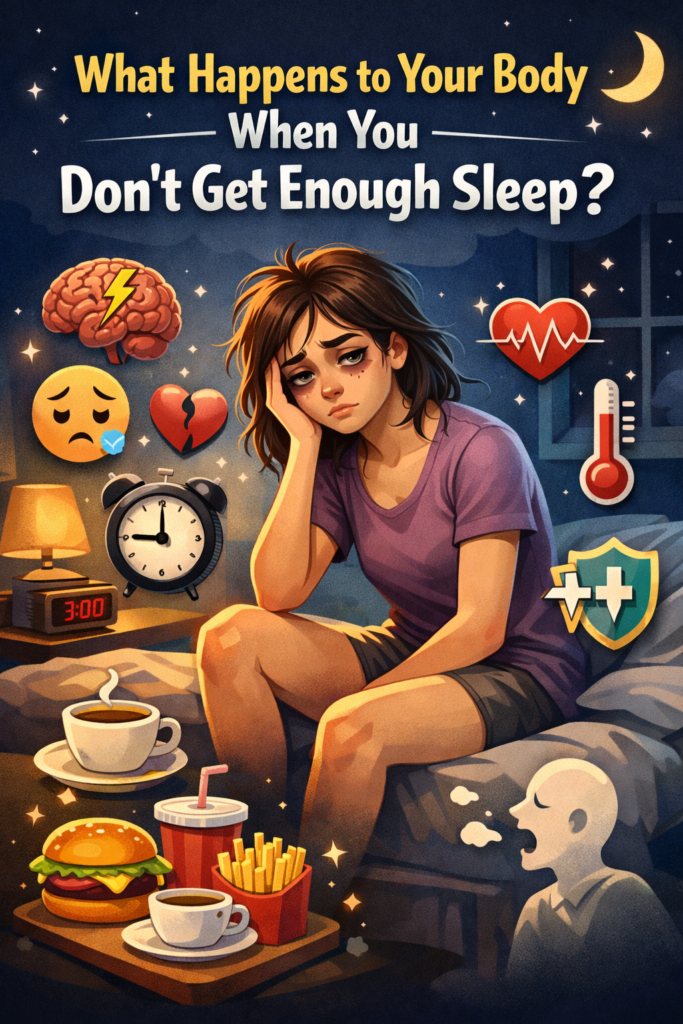
Understanding What Happens to Your Body When You Don’t Get Enough Sleep? is a critical component of health literacy. Sleep deprivation does not announce itself dramatically at first. It begins subtly. A slight fog in the mind. A shorter temper. A lingering sense of fatigue that caffeine can no longer mask.
Over time, these minor disturbances accumulate.
Cognitive and Neurological Consequences
One of the earliest systems affected by inadequate sleep is the brain. Health education emphasizes the link between sleep and cognitive acuity because learning, memory consolidation, and decision-making all depend on sufficient rest.
When sleep is compromised, attention span diminishes. Reaction times slow. Complex problem-solving becomes laborious. The brain’s prefrontal cortex, responsible for judgment and impulse control, becomes less efficient. This neurological fatigue can lead to poor choices, reduced productivity, and impaired learning capacity.
In educational contexts, both formal and informal, sleep deprivation undermines the very goal of health education: informed decision-making.
Emotional Regulation and Mental Resilience
Sleep also plays a pivotal role in emotional equilibrium. Health education frameworks often include mental and emotional well-being, recognizing that psychological health is inseparable from physical health.
Without adequate sleep, the brain’s emotional centers become hyperreactive. Minor stressors feel overwhelming. Patience erodes. Mood volatility increases. Over time, chronic sleep loss can weaken emotional resilience, making it harder to cope with daily challenges or maintain healthy interpersonal relationships.
Understanding What Happens to Your Body When You Don’t Get Enough Sleep? helps individuals recognize that persistent irritability or emotional numbness may not be a personality flaw, but a physiological response to rest deprivation.
Physical Health and Systemic Effects
From a physiological standpoint, sleep deprivation affects nearly every system in the body. Health education teaches that the body operates as an interconnected network, not isolated parts.
When sleep is insufficient, metabolic regulation becomes disrupted. Appetite-related hormones may fluctuate, increasing cravings for calorie-dense foods. Energy levels decline, reducing motivation for physical activity. Immune function may weaken, leaving the body more susceptible to common illnesses.
Muscle recovery slows. Cardiovascular strain increases. Over time, these systemic imbalances can compound, illustrating why sleep education is integral to preventive health strategies.
Sleep, Behavior, and Daily Choices
Health education does not exist in theory alone. Its value lies in application. Sleep deprivation often alters behavior in ways that further compromise health. Shortened sleep can lead to irregular eating patterns, skipped meals, or excessive reliance on stimulants. It can also reduce the likelihood of engaging in physical movement or maintaining consistent routines.
This creates a feedback loop. Poor sleep leads to unhealthy behaviors. Unhealthy behaviors further degrade sleep quality.
By understanding What Happens to Your Body When You Don’t Get Enough Sleep?, individuals gain the awareness needed to interrupt this cycle and make intentional adjustments to daily habits.
The Educational Value of Sleep Awareness
Health education thrives on clarity and relevance. Sleep awareness is effective because its effects are immediately observable. People can feel the difference between a well-rested day and a sleep-deprived one. This experiential learning reinforces abstract concepts, making health education more tangible and impactful.
Educational initiatives that address sleep encourage self-observation. They promote routine evaluation of bedtime habits, screen exposure, workload balance, and stress management. Over time, this awareness cultivates autonomy, empowering individuals to take ownership of their well-being.
Building a Holistic Health Perspective
True health education does not isolate topics. It connects them. Sleep intersects with nutrition, mental health, physical performance, and emotional stability. When one element falters, others follow.
Understanding What Happens to Your Body When You Don’t Get Enough Sleep? is not about inducing fear. It is about fostering comprehension. It reframes sleep as an active investment rather than a passive luxury.
In a world driven by productivity and constant stimulation, health education serves as a counterbalance. It reminds individuals that restoration is not a weakness, but a biological necessity.
Conclusion
Health education empowers people to see the body as an intelligent system that communicates through signals, sensations, and patterns. Sleep is one of its most eloquent languages. Ignoring it diminishes clarity, resilience, and vitality.
By integrating sleep awareness into health education, individuals are better equipped to make informed choices, sustain long-term well-being, and cultivate a balanced life. Knowledge alone is not enough. Understanding, applied consistently, becomes the foundation of lasting health.